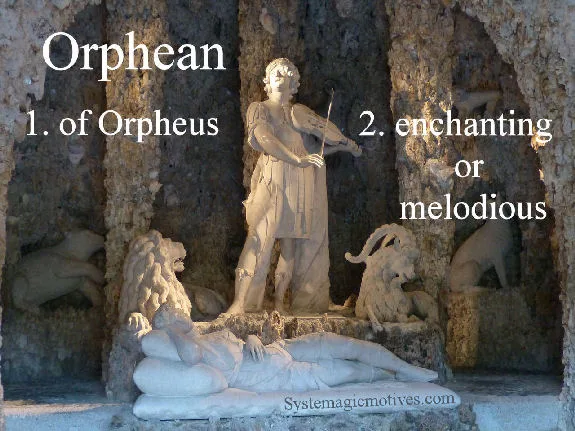
Orphean adj. 1. Of Orpheus.
2. Enchanting, lyrical, or melodious.
The word "Orphean" comes from the mythological figure Orpheus, a legendary musician, poet, and prophet in Greek mythology. Orpheus was said to have the ability to charm all living things with his music, so much so that even inanimate objects like trees and rocks would move to the sound of his lyre. As a result, the term "Orphean" is used to describe anything that is melodious, enchanting, or capable of evoking deep emotion, especially through music or poetry. It suggests a quality of art that captivates the soul and stirs the heart with its beauty or grace.
In a literary or artistic context, "Orphean" is often used to elevate works of art that are especially harmonious, lyrical, or transcendent, possessing a kind of ethereal, almost magical quality. It implies a power beyond the ordinary, one that can transport listeners or readers into a different state of being, much like the mythological Orpheus's music. The word captures the idea of an almost divine beauty that moves the spirit in profound ways.
"Music is the universal language of mankind."
- Henry Wadsworth Longfellow
An Orphean chord rose from down low,
steady enough to lift the whole show;
it made a scattered room align,
with loud and low made exquisitely fine.
Renaissance musicians and poets regularly invoked Orpheus as an emblem of art's civilizing power, helping keep the adjective orphean alive in literary English.
Orphean music,
Softly floating through the air,
Hearts bound with the tune.