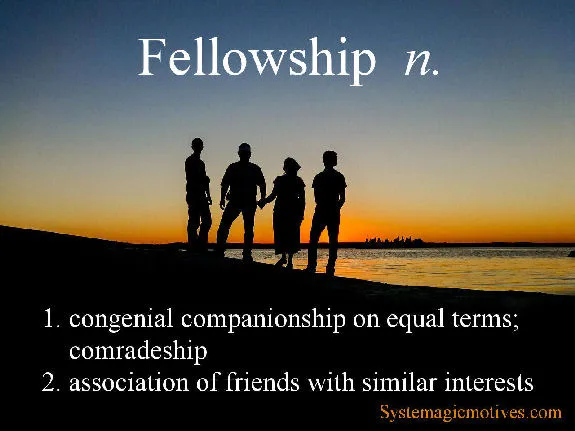
Fellowship n. Companionship grounded in shared purpose, trust, and mutual care.
Fellowship is the lived experience of standing together in shared purpose, goodwill, and mutual regard. It is more than casual sociability: it implies trust that grows through consistency, participation, and reciprocal care. Where fellowship is present, people do not simply coexist; they contribute to one another's stability and momentum. In families, teams, congregations, classrooms, and communities, fellowship creates the social fabric that makes cooperation durable rather than temporary.
At its strongest, fellowship combines belonging with responsibility. It invites warmth, but it also asks for reliability: listening well, showing up, carrying one's part of the work, and honoring the dignity of others. This is why fellowship has both emotional and practical force. It eases isolation, reduces conflict, and makes difficult goals more attainable because effort is shared. In that sense, fellowship is not an ornament to life but an operating principle for healthy human systems.
Social scientists have found that even brief moments of genuine fellowship - shared laughter, shared purpose, or shared presence - can raise oxytocin levels enough to measurably increase trust between people who were strangers only minutes before, making fellowship one of the fastest ways humans form real social bonds.
"We are obliged to respect, defend and maintain the common bonds of union and fellowship that exist among all members of the human race."
- Cicero
In quiet circles shaped by trust, we find our fellowship,
A bond that steadies wandering hearts and strengthens, too, our grip;
It grows in simple moments shared, in kindness freely shown,
A gentle proof that none of us are meant to stand alone.