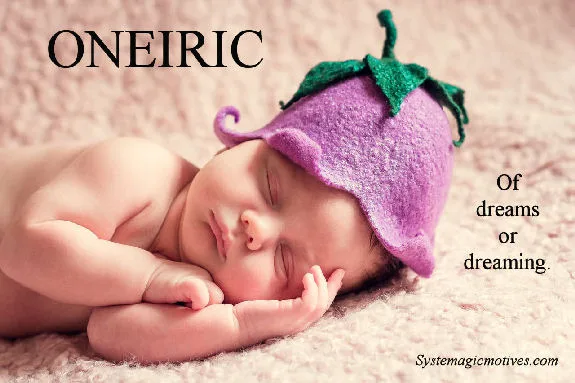
Oneiric adj. Relating to dreams or to dreamlike imagery and states.
The word oneiric is derived from the Greek word oneiros, meaning "dream." It is used to describe things that are related to dreams, or that have qualities resembling those of a dream. In literature, art, or psychology, oneiric often refers to a surreal or fantastical atmosphere that mirrors the logic, imagery, and irrationality of dreams. It can evoke a sense of unreality, distortion, or the blending of fantasy and reality.
In a more psychological context, oneiric might be used to describe experiences or phenomena that resemble the dream state, such as altered states of consciousness or perceptions that are not entirely grounded in the physical world. It also carries a sense of being detached from the rational, often invoking feelings of mystery or the unknown.
"All that we see or seem is but a dream within a dream."
- Edgar Allan Poe
During REM sleep, the brain region that handles visual imagination becomes more active than when you are awake, while the prefrontal cortex - the part that checks logic, order, and continuity - powers down. That is why dreams can feel vivid, cinematic, and wildly convincing, even when the events make no sense. It is your brain running the imagination engine at full power with the editor temporarily off duty.
Oneiric visions,
Moonlit paths through sleep's embrace,
Dreamscapes softly weave.