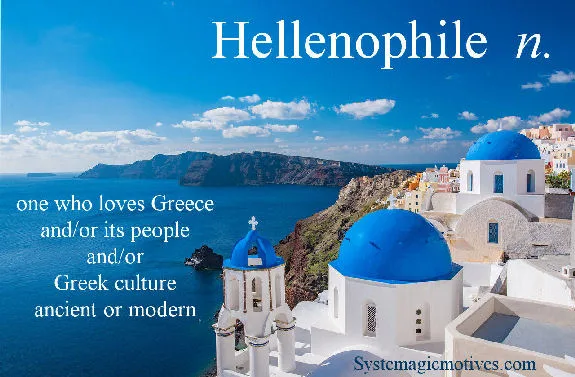
Hellenophile n. One who loves Greece and/or its people and/or Greek culture ancient or modern.
Hellenophilia n. 1. The love of all things Greek. 2. The theory that modern science began in Greece.
Hellenophile names an admirer of Greek culture in its many forms, language, philosophy, drama, architecture, civic thought, and living contemporary traditions. The word can describe scholarly engagement, artistic affinity, or simple heartfelt appreciation. At its best, hellenophilia is not nostalgic idealization but attentive learning: respect for historical depth alongside recognition of modern Greece as a vibrant, evolving culture.
The term combines Helleno- (Greek) with -phile (lover). In practical terms, a hellenophile may read Greek writers, study classical sources, explore Hellenic history, and support Greek arts and communities today. The value of the word lies in orientation: curiosity with discipline, admiration with context, and affection that grows through study rather than stereotype.
"Every man has within him an ideal man, just as every piece of marble contains in a rough state a statue as beautiful as the one that Praxiteles the Greek made of the god Apollo."
- Jose Marti
In the early 19th century, so many European scholars were studying ancient Greek texts that universities began offering "Greek-only" debate societies, where members were required to speak exclusively in Ancient Greek. Participation rates were surprisingly high, showing that genuine Hellenophilia wasn't just admiration - it drove people to actively use the language in intellectual exchange.
A Hellenophile by page and stone,
finds old and living worlds as one.
From thought to art, from sea to square,
Greek loves and language gather there.