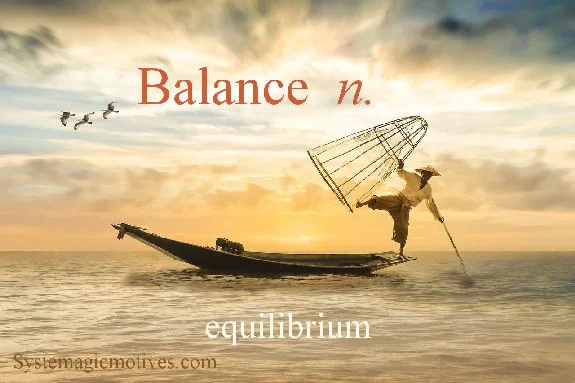
Balance n. A state of stable proportion and harmony.
Balance names the practice of proportion: enough structure to stay steady, enough adaptability to keep growing. It appears in practical choices such as how we divide time, manage attention, and pace effort across responsibilities. In this sense, balance is not a frozen midpoint; it is an ongoing calibration that responds to changing conditions. Healthy balance allows movement without chaos and commitment without collapse, helping people remain clear, effective, and emotionally grounded over longer stretches of life and work.
At a deeper level, balance also describes relational and inner harmony: thought aligned with action, ambition tempered by restoration, and conviction softened by perspective. People who cultivate balance tend to make better long-range decisions because they resist extremes and return to deliberate rhythm. Rather than reacting to every pressure, they create room for judgment, reflection, and steady progress. Used this way, balance becomes both a personal discipline and a social gift, supporting stability, trust, and sustainable well-being.
"So divinely is the world organized that every one of us, in our place and time, is in balance with everything else."
- Johann Wolfgang von Goethe
Researchers studying posture and motor control have found that humans make tiny, constant adjustments-called "micro-corrections"-to stay balanced, even when standing perfectly still; these subtle shifts are so continuous that over the course of a quiet minute, your body may sway several centimeters without you ever noticing.
Balance is not a rigid line,
but living rhythm shaped by time.
It steadies motion, choice, and pace,
and keeps our strengths in their right place.