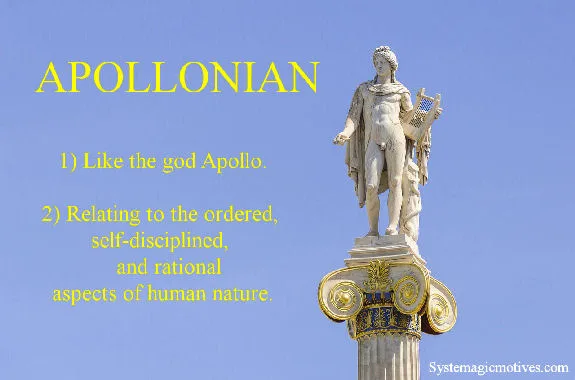
Apollonian adj. 1. Ordered, lucid, harmonious, and classically proportioned.
2. Like the god Apollo.
Apollonian describes a mode of order shaped by clarity, proportion, and disciplined beauty. In language, art, and thought, the word points to forms that are composed rather than chaotic, balanced rather than excessive, and intelligible rather than obscure. It is often used when structure itself creates elegance: where each part has a place, each contrast is measured, and the whole feels coherent.
In intellectual history, Apollonian is frequently contrasted with more ecstatic or impulsive energies, not as an enemy of emotion but as a way of refining it. An Apollonian approach gives feeling durable form through craft, restraint, and pattern. Whether in architecture, music, or argument, the term suggests that harmony is not accidental: it is made through thoughtful arrangement, patient attention, and proportion held in view.
"Order is heaven's first law."
- Alexander Pope
In 19th-century art theory, critics sometimes described a perfectly composed painting as "Apollonian" - and one Paris salon even hung such works in a special section nicknamed la galerie d'Apollon, where visitors joked that the lighting was so even and calm that "nothing dared cast a shadow." It became a playful badge of honor for artists whose work embodied clarity and balance.
Apollonian forms in quiet line,
make thought and feeling both align.
Through measured shape and lucid art,
harmony teaches mind and heart.