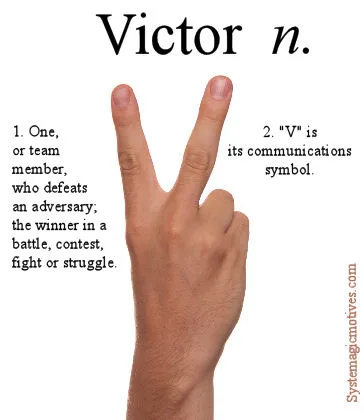
Victor n. One who defeats an adversary; a winner in contest or struggle.
Victor names the one who prevails, but the word has more substance than simple winning. At its best, it implies tested effort, maintained focus, and a threshold crossed through skill, endurance, or principled persistence. A true victor is not merely last-standing by chance; the victor has met resistance and answered it with capacity.
A victor, then, is not merely the beneficiary of circumstance but the embodiment of an earned ascent. The title carries an expectation of comportment-of meeting success with steadiness, humility, and an awareness of the path that led there. Victory, in this sense, is less about dominance than about integration: the moment when preparation, resilience, and right action converge. To be a victor is to stand in that convergence with clarity, acknowledging both the struggle that shaped you and the responsibility that follows achievement.
"To the victor belong the spoils of the enemy." - William L. Marcy (1832).
At the first modern Olympics in 1896, first-place winners did not receive gold medals; they received silver medals and olive branches.
Gold for first place became the standard later, showing that even how we symbolize the victor has changed over time.
The victor is not the loudest cry,
But tested will that does not die.
Through loss and lift, through night and strain,
A steadied heart that earns its gain.