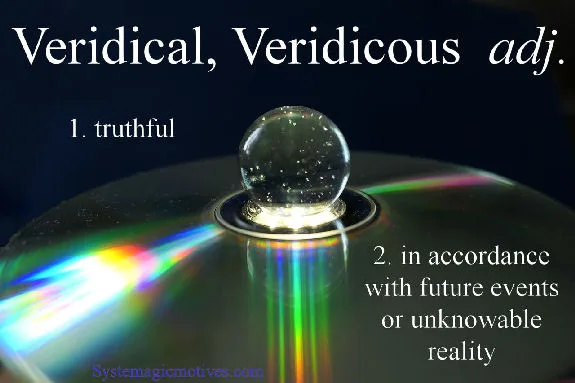
Veridical, Veridicioius adj. 1. Truthful.
TruthVeraciousVeriloquentSoothSoothfastAmenIndubitableIrrefragable
The word veridical comes from the Latin veridicus , meaning "truth-telling" or "honest," and refers to something that is truthful, accurate, or corresponds to reality. It is often used in philosophical, psychological, or literary contexts to describe statements, perceptions, or experiences that are genuine or in alignment with the truth. For example, a veridical memory is one that faithfully represents events as they truly occurred, without distortion or fabrication. The term can also be used more broadly to describe things that are honest or reflect reality, emphasizing the authenticity and correctness of the information being conveyed.
In modern usage, veridical is more commonly found in discussions about perception, where it refers to experiences or observations that accurately reflect the world around us. It contrasts with non-veridical experiences, which may be illusions or distortions of reality. The term evokes a sense of reliability and trustworthiness, suggesting that something is aligned with truth and can be depended upon as being accurate.
"Three things cannot be long hidden: the sun, the moon, and the truth." - Buddha.
In cognitive science, one of the most important distinctions is between confidence and veridical accuracy. People can recall a vivid memory with high confidence and still be wrong about key details.
That is why modern legal and scientific standards rely on corroboration and repeatable evidence: veridical truth is measured by what can be independently verified, not only by how certain someone feels.
Veridical words stand clear and bright,
a steady flame in clouded night.
They cut through doubt with honest aim,
and anchor truth in thought and frame.