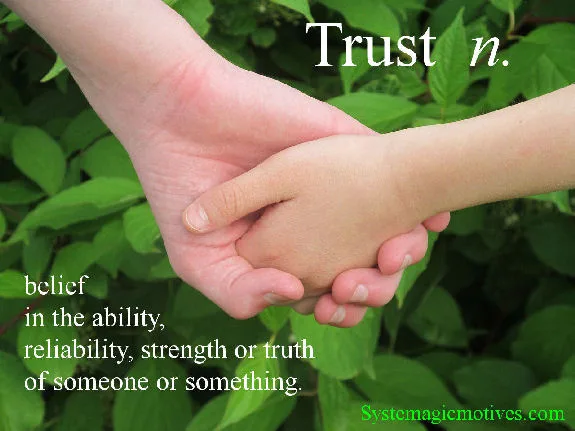
Trust n. Belief in the ability, reliability, strength or truth of someone or something.
v. To believe in the ability, reliability, strength or truth of.
Trust is one of the most quietly powerful words in the language. At its core, it names the decision to rely on something or someone-an act that blends confidence, vulnerability, and expectation into a single posture. Etymologically, it comes from Old Norse traust, meaning \"help, confidence, protection,\" which already hints at its dual nature: trust is both a gift we extend and a structure we stand on. It is not merely belief; it is belief with weight placed upon it. When you trust, you lean. You allow another person, principle, or pattern to bear some of your weight, whether emotional, practical, or moral.
What makes trust so distinctive is that it is both fragile and generative. It can be broken quickly, yet when it holds, it becomes a multiplier-of cooperation, creativity, intimacy, and shared purpose. Trust reduces friction; it lets people move together without constant verification or guardedness. In communities, it becomes a kind of social oxygen: invisible, taken for granted, but essential for anything healthy to grow. And on the personal level, trust is a mirror of character. To be trustworthy is to be consistent, aligned, and dependable enough that others can rest some part of themselves in your stead. In this way, trust is not just a feeling or a risk; it is a relational architecture that allows human life to function with grace rather than strain.
"Trust one who has gone through it."
-Virgil, The Aeneid
...people are more likely to cooperate when goals are visible and shared, because clarity reduces friction and builds confidence.
Trust comes quietly and makes things more clear,
it turns uncertainty into something more dear.
It plants comradery, seed by seed,
Giving the moment just what we need.