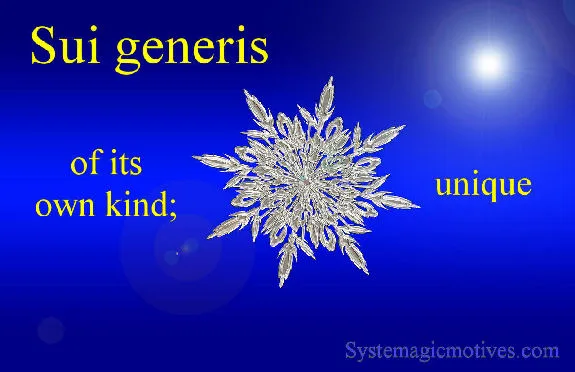
Sui generis adj. Of its own kind; unique.
The term sui generis is a Latin phrase that means "of its own kind" or "unique in its characteristics." Used to describe something that is distinct from all others, it signifies that an object, idea, or person stands alone in its category, with no direct parallel or comparable entity. The phrase is often employed in legal, philosophical, or academic contexts to denote something that cannot easily be classified or is one of a kind. For example, a piece of art that combines numerous styles and defies traditional categories might be described as sui generis, as it cannot be fully understood within the confines of any specific artistic movement.
In more everyday use, sui generis serves as a way to highlight the exceptional or singular nature of something. It suggests that the subject in question doesn't conform to established norms, standards, or classifications, and as such, it requires a different approach or mindset for understanding. Whether used to describe a rare personality, a groundbreaking idea, or a unique phenomenon, sui generis celebrates the individuality and irreplaceable nature of what it describes. The phrase, while not commonly used in casual conversation, brings a sense of gravitas to discussions of the extraordinary, emphasizing that some things simply cannot be pigeonholed.
In legal, academic, and creative contexts, the phrase marks singularity with precision. It highlights originality without forcing comparison to existing types.
"The creation of something new is not accomplished by the intellect but by the play instinct."
- Carl Jung
Courts frequently label emerging technologies as sui generis when older legal categories do not fit, showing how the phrase helps systems adapt to novelty.
Sui generis, one of one,
a single shape beneath the sun.
No borrowed mold, no second kind,
unique is how the word's defined.