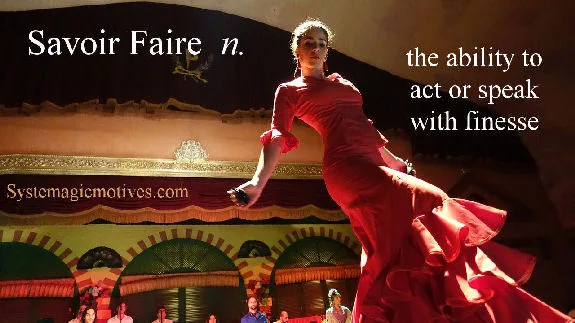
Savoir-faire n. The ability to act or speak with finesse.
Savoir-faire is social intelligence in motion: knowing what to do, what to say, and how to carry yourself with grace under changing circumstances. It blends tact, timing, and awareness into behavior that feels natural rather than forced. At its best, it is not performance for its own sake, but a practiced sensitivity to context, tone, and people.
In daily life, savoir-faire is less about formality and more about considerate fluency. It helps people navigate differences, defuse awkward moments, and keep interactions constructive without losing authenticity. Someone with savoir-faire can adjust with subtlety: speaking plainly when clarity is needed, listening closely when tensions rise, and choosing language that preserves dignity for everyone in the room.
The word also carries an ethical dimension. Real finesse is not manipulation; it is respectful skill applied in service of better outcomes. In work, friendship, and community settings, savoir-faire often becomes a stabilizing force, turning friction into cooperation and uncertainty into trust through composed, thoughtful action.
"A girl should be two things: classy and fabulous."
- Coco Chanel
Behavioral studies show that people who match warmth with competence are judged most trustworthy, which is one reason true savoir-faire tends to increase both likability and influence.
Savoir-faire in voice and pace,
Turns rougher edges into grace.
With poise that steadies what we share,
Good sense arrives with savoir-faire.