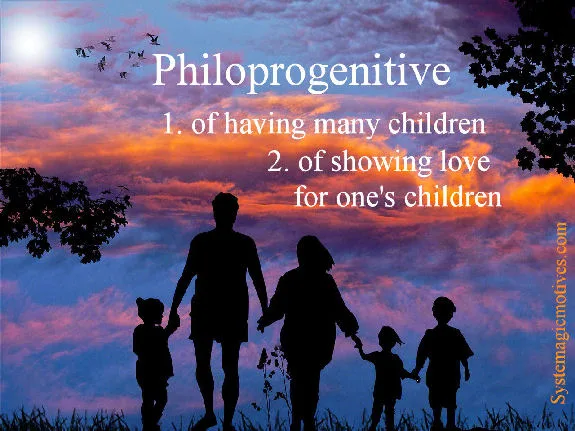
Philoprogenitive adj. 1. Of having many children.
2. Of showing love for one's children.
"Philoprogenitive" is an adjective derived from the Greek words philo- meaning "loving" and progenitive meaning "producing offspring." It refers to a strong inclination or love for procreation, or a tendency to have many children. The term can also describe a characteristic or behavior that is nurturing or related to the act of generating or fostering new life. It emphasizes a deep affection for or a natural tendency toward the creation and care of offspring.
While "philoprogenitive" can be used in a biological context to describe organisms or species that are particularly focused on reproduction, it can also have a more figurative or cultural implication, referring to a mindset or society that values or prioritizes family and offspring.
"Father and mother, brothers and sisters, all working, playing, and living together, make home the happiest place in the world."
- Louisa May Alcott, Little Women
In Victorian England, philoprogenitive became a favourite word among early social observers who were fascinated by large families. Census takers sometimes used it informally to describe households where children seemed to arrive in steady succession - not as a judgment, but as a notable family trait. The term was even used in early psychology to label the tendency to delight in children's company, long before modern developmental science existed.
Philoprogenitive skies,
Give birth to fields of grain,
Where life springs forth anew,
From the earth's gentle reign.