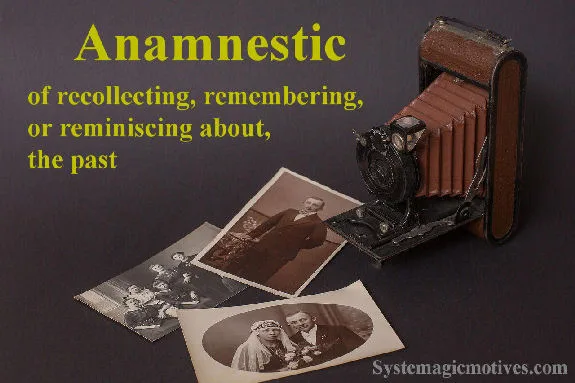
Anamnestic adj. Of recollecting, remembering, or reminiscing about, the past.
"Anamnestic" is an adjective that comes from the Greek word anamnestikos, which means "pertaining to memory" or "recollective." It refers to something related to the process of remembering or recalling past events. In medical or psychological contexts, "anamnestic" can be used to describe a form of memory or recollection, particularly when it involves recalling a patient's medical history or past experiences. The term can also be used more generally to refer to something that stimulates or is connected with the process of remembering.
In a broader sense, "anamnestic" can describe moments, actions, or even objects that trigger memories or reflections. Whether it is an anamnestic moment that brings a rush of nostalgia or a conversation that sparks recollection, the word is often used to emphasize the act of memory retrieval or the power of reminiscence.
"The soul is immortal, and has learned all things; so that what we call learning is only recollection."
- Plato, Meno, trans. Benjamin Jowett
In classical historiography, anamnestic methods were used long before modern science: ancient Greek orators trained themselves to recall entire speeches by walking mentally through a "memory path," retrieving each section from an imagined location. This early anamnestic technique - now called the method of loci - is still used today by memory champions because it reliably boosts long-term recall.
Through anamnestic whispers of the past,
Memories bloom from the shadows they cast.
Threads of time weaving what we hold dear,
Their echoes remaining kept forever near.