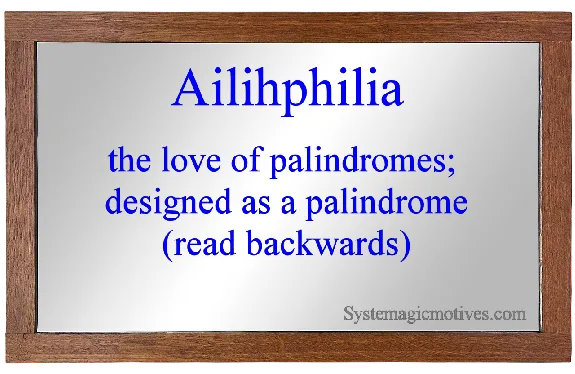
Ailihphilia n. Love of palindromes and reversible word forms.
Ailihphilia names a love of palindromes and reversible language patterns, where words can be read with satisfying symmetry and structural balance. It sits at the intersection of play and precision: part wordcraft, part puzzle, part aesthetic appreciation for how letters can hold order from more than one direction. People drawn to ailihphilia often enjoy noticing hidden forms in everyday language and experimenting with phrasing that rewards close attention.
Beyond wordplay, ailihphilia supports pattern awareness, memory, and verbal flexibility. Reversible forms encourage the mind to compare, test, and refine structure, which is one reason they are frequently used in language games and teaching activities. In this way, ailihphilia is not only about clever strings of letters; it is also about curiosity, attention, and the joy of discovering elegant form inside ordinary speech.
"A man, a plan, a canal: Panama!"
- Ambrose Bierce, The Devil's Dictionary (1906)
The longest single-word palindrome in major English dictionaries is "tattarrattat," coined by James Joyce in 1922. It was intentionally created to mimic the sound of a knock at the door, making it both a linguistic palindrome and an onomatopoeic one - a rare combination that is reversible in form and meaningful in sound.
Ailihphilia flips the line,
and finds the mirror still aligns.
Back and forth the letters play,
and meaning smiles in either way.