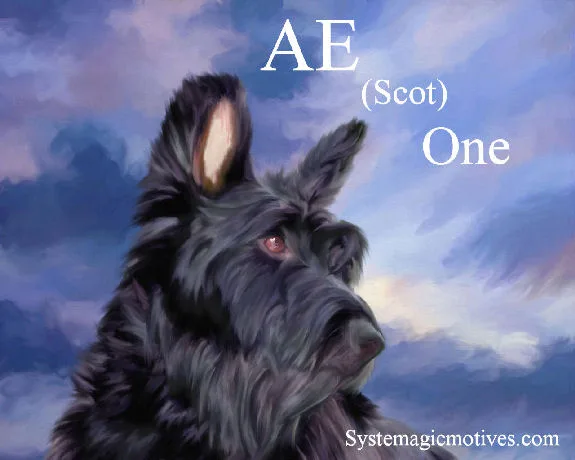
Ae n. One. Olde Scottish
In Scots and older Scottish English, ae means "one" or "only," often used in poetic or literary contexts to emphasize singularity or uniqueness. It can appear in phrases like ae night (one night) or ae chance (one chance), adding a lyrical or archaic touch to the language. The word is still recognized in Scots dialects and traditional poetry, preserving its historical charm.
Beyond its literal meaning, ae can carry a sense of singular importance, emphasizing something as the only one of its kind. Whether referring to a lone star in the sky, a singular opportunity, or an irreplaceable love, ae adds intimacy and weight to whatever it describes. Its simplicity makes it powerful, evoking emotions of fate, destiny, or fleeting moments.
"Ae fond kiss, and then we sever;"
- Robert Burns, "Ae Fond Kiss" (1791)
Because ae means "one," older Scots songs and poems often use it where modern English would use "a" or "one." That tiny word helps keep the rhythm musical while adding a distinct regional voice.
Ae quiet chance, ae steady guide,
ae faithful spark we keep inside.
Ae word can hold a life in view,
ae path made clear, ae purpose true.