Overview
"The position as the continent Atlantis occupied, is that as between the Gulf of Mexico on the one hand and the Mediterranean upon the other... notably in Bimini and in the Gulf Stream through this vicinity, these may even yet be determined." Edgar Cayce 364-3
Modern-day prophet Edgar Cayce described where Atlantis evidence might be found. Bimini is commonly presented as one of the key areas found in his readings.
Bimini
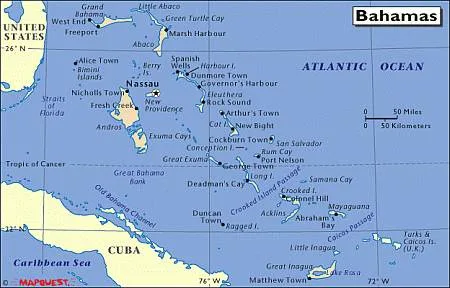
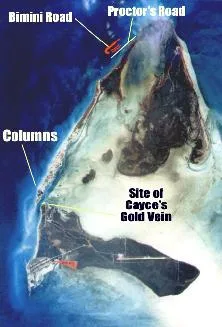
The Gulf Stream and Regional Context
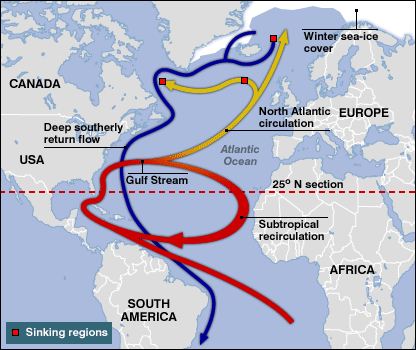
The Gulf Stream moves north through Bimini and crosses areas linked by Cayce readings to earlier Atlantean geography. Those readings describe multiple destructive flood eras, culminating in a final catastrophe around 10,014 BC.
Bermuda Triangle
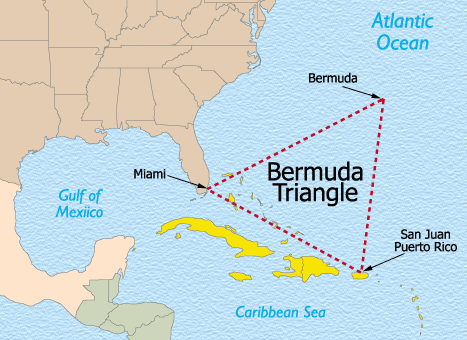
Bimini lies near one corner of the Bermuda Triangle. Researchers associated with the Association for Research and Enlightenment have connected part of their search work in this wider region.
"Poseidia will be among the first portions of Atlantis to rise again. Expect it in sixty-eight and sixty-nine. British West Indies or Bahamas." Edgar Cayce 958-3
Bimini Road
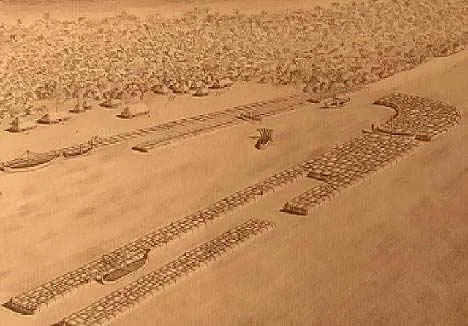
In September 1968, Dr. J. Manson Valentine reported a geometrical J-shaped stone formation in roughly 23 feet of water off North Bimini. This approximately 1,900-foot formation became widely known as "Bimini Road."
Rising and Structural Claims
Some reports assert that Bimini Road appears at shallower depth than earlier surveys, supporting a recurring claim that this region rises and falls geologically.
In 1975, Dr. David Zink reported a worked tongue-and-groove stone fragment embedded at the site. The piece was described as man-made yet difficult to classify by conventional architectural comparison.
Skeptical Challenges and Responses
- Claim: No slabs are squarely stacked. Response: Later field photos were cited as showing large tiered slabs.
- Claim: No tool marks exist. Response: Reports cite mortise-like stones and worked edges.
- Claim: No support stones are present. Response: Research teams reported and documented leveling stones beneath larger blocks.
- Claim: Core samples show one contiguous natural formation. Response: Counter-arguments cite differences between component stone cores.
- Claim: All stones are natural beachrock. Response: Counter-arguments assert mixed materials and potential intentional harbor use.
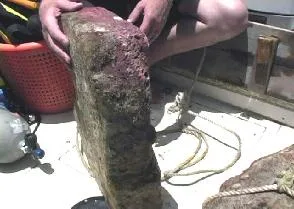
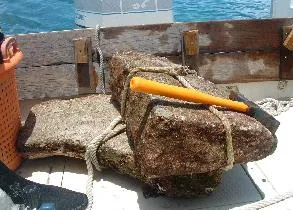
Field narratives also mention additional harbor-like formations, including a site nicknamed "Paradise Point Pier," exposed after storm-related sand movement in 2006.
"The temple will rise again." Edgar Cayce 958-3
Temple Roof Apex
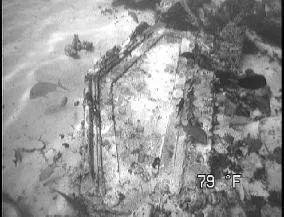
In 2007, teams reported a triangular polished stone slab in debris-covered zones north of Bimini. The piece was described as potentially architectural, with smaller edge fragments identified as white marble.
In Sixty-Nine
An enigmatic structure, shaped like a cursive "e," was reported in 1969. Later expeditions near Joulters Cays described an underwater wall composed of multi-layer limestone blocks and smaller cubed stones.
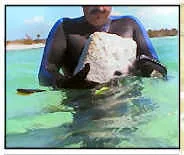
Accounts describe shallow-tide access, stacked visible layers, and rough tool-like markings. These interpretations remain debated but are frequently cited in Atlantis-related field discussions.
The ARE Search Context
The background to A.R.E.'s Search for Atlantis project appears in several books, including:
"It would be well if this entity were to seek either of the three phases... the one in the Atlantean land... another in the place of the records that leadeth from the Sphinx... and another in the Aryan or Yucatan land." Edgar Cayce Reading 2012-1
"Give in detail what the sealed room contains." ... "A record of Atlantis... Between, then, the Sphinx and the river." (378-16)
In March 1927, Cayce reading 996-12 referenced lands west and south of Bimini as areas that would be uncovered. Cuba has been included in some later discussions because of its position relative to Bimini.
Much field exploration funded by A.R.E. has involved archaeologist Dr. Greg Little. This article mentions work near Cuba.
Artifact
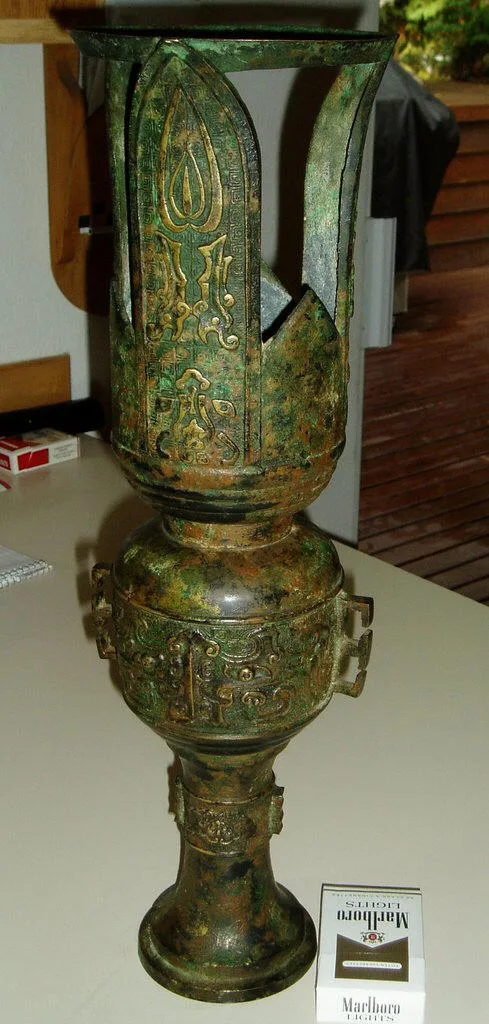
This artifact was reportedly found off the Florida coast roughly a century ago. Accounts say auction houses and universities struggled to classify its origin and inscriptions, and that it passed through private custody after a museum closure before being photographed again.
Some researchers ask whether it could have served a ceremonial purpose, perhaps even involving a preserved flame tradition analogous to Vesta motifs.
The broader question remains whether major discoveries depend on the opening of the hall-of-records traditions (Egypt, Yucatan, Atlantis), and on what Cayce described as a reduction in humanity's selfish motives.
"It will be necessary to wait until the full time has come for the breaking up of much that has been in the nature of selfish motives in the world." Edgar Cayce 2329-3